The Global Resilience NetworkGlobal Challenges Forum Foundation
Global Resilience
Consortium
Consortium home

The Age of Convergence · Book II

How the five initiatives fit together

The Consortium connects independent institutions and communities. Book II describes the capabilities they can build together.

Implementation framework

The Consortium connects the whole

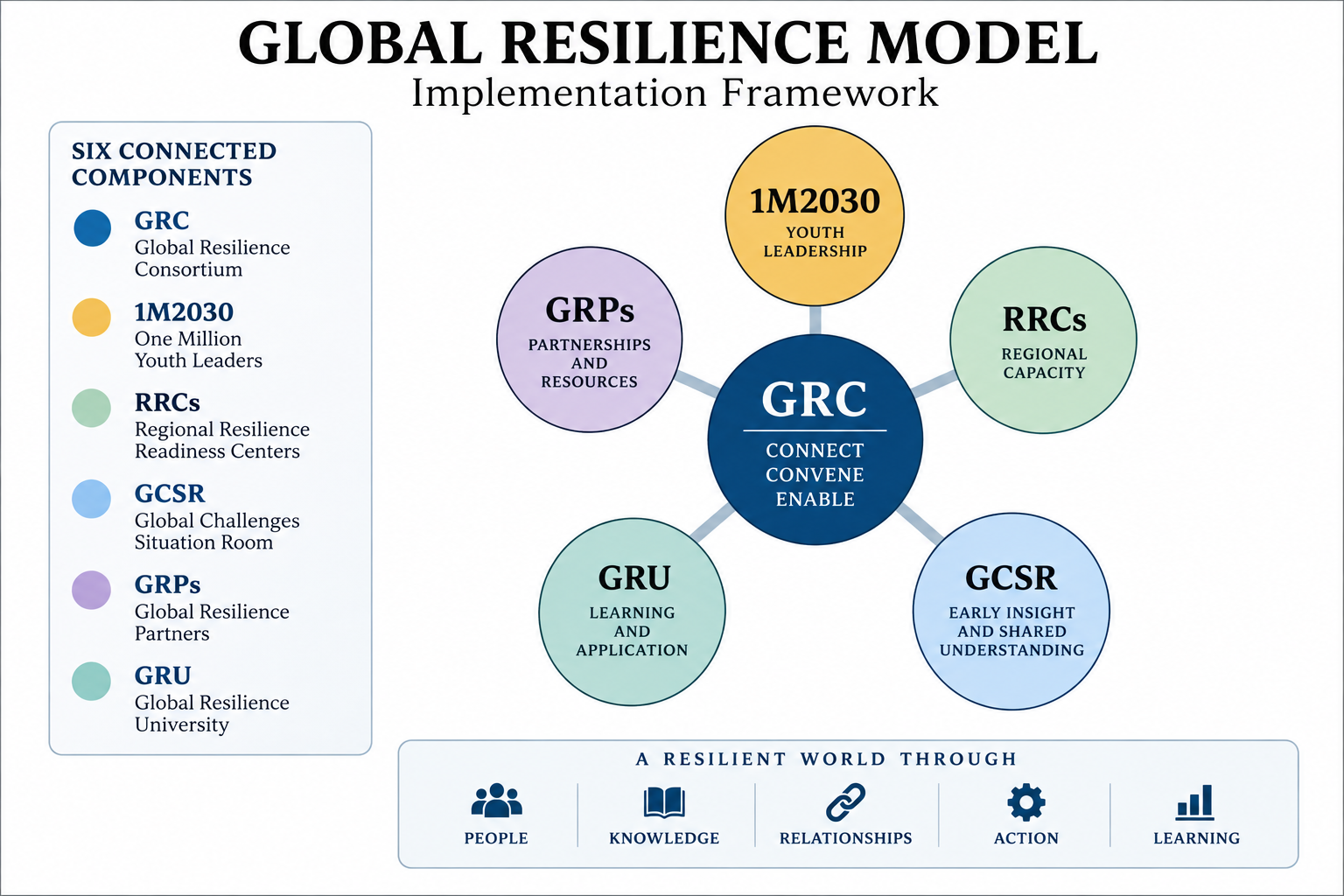
Book II places the Consortium at the center because it can convene people, broker relationships and help resources reach credible initiatives. Universities, civil society, public bodies, businesses and youth organizations bring different kinds of knowledge and authority. They retain responsibility for the commitments they make.

The annual online General Assembly gives member institutions a place to choose what the Consortium will sustain. Members might weigh the cost of convening regional hosts, supporting a global trends outlook or expanding access to international youth exchanges. Those are choices about the direction and resources of the network.

How an institution can join and be represented
Global Resilience Consortium at the center, independently linked to youth leadership, regional capacity, global analysis, shared learning and partnerships.
Open the implementation framework at full size

Institutional support

Who sustains each capability?

Through Global Strategic Resources, the Consortium can draw on two administrative providers. Members set direction through the Assembly. Providers organize the work entrusted to them.

Global Strategic Analysis

Global Resilience Partners
Identify individual and institutional partners, map expertise and build relationships across countries and sectors.
Regional Resilience Readiness Centers
Identify prospective hosts and participating institutions, develop regional capacity assessments and support exercises and exchanges.
Global Challenges Situation Room
Organize an international network of analysts, maintain a global watchlist and prepare comparative outlooks on emerging developments.
Visit Global Strategic Analysis

LEADS Institute

1M2030
Connect youth organizations and campuses with mentors, institutional hosts and exchange opportunities across countries.
Global Resilience University
Support academic partnerships, faculty exchanges, curriculum and a shared body of cases and methods. LEADS publishes The Age of Convergence trilogy.
Visit LEADS Institute
The origins of 1M2030 and the University

The Kathmandu Vision

In October 2018, Walter Christman and Sebastian Hofbauer traveled from New Delhi to Kathmandu to develop what would become 1M2030. There they encountered Nepali high-school and college students marching in support of the Me Too movement. The students were already exercising leadership by speaking out about power, dignity, and whose voices were heard.

That encounter gave rise to the Kathmandu Vision. Christman and Hofbauer saw that the generation that would live longest with today’s decisions needed a hand in making them. Mentorship, practical opportunities, and access to institutions could help young people turn the leadership they were already showing into lasting influence in their communities.

The Delhi Proclamation

Earlier that month, on October 3, the Global Challenges Forum Foundation and the United Nations Institute for Training and Research (UNITAR) co-convened the Global Resilience Conference on Integrated Learning and Leader Development in New Delhi. The resulting proclamation set out two linked commitments. It called for raising one million youth leaders to carry the UN Sustainable Development Goals beyond 2030, and called for exploring how to establish a Global Resilience University to connect learning with action.

The Foundation and UNITAR launched 1M2030 at the Palais des Nations in Geneva on September 27, 2019, where young leaders presented sustainable development projects from their own communities.